| Home Page | Buying | Maps | Books | Prints | Ephemera |
- Home Page
- Bird Prints
- Meyer's British Bird Prints 1842-6
- Mammal Prints
- Amphibian, Butterfly, Fish, Insect, Shells & Reptile Prints.
- Butterflies & Moths Chromos
- ORIGINAL ART & FRAMED PRINTS
- Flower, Herb & Plant Prints
- World Views
- UK Views London & Middlesex
- UK Views Gloucestershire
- UK Views Somerset & Bristol
- UK Views Southern England
- UK Views Northern England
- Views Scotland, Wales & Ireland
- Astronomy, Cartoons, Cruikshank, Geology, Heraldry, History, Hunting, Leech, Phiz, Science, US Vintage Autos, Warfare, etc.

Northern England covers Herefordshire, Worcestershire, Warwickshire, Leicestershire, Rutland, Lincolnshire and all English counties to the North. Items are grouped together by county and the counties are in alphabetical order.
All our prints are Originals. They are NOT modern reproductions or electronic copies. Images are of the item for sale and may exaggerate blemishes and alter colours. I endeavour to mention any damage. The size given is of the sheet overall, unless otherwise stated, which is the image shown including margins.
All our prints are Originals. They are NOT modern reproductions or electronic copies. Images are of the item for sale and may exaggerate blemishes and alter colours. I endeavour to mention any damage. The size given is of the sheet overall, unless otherwise stated, which is the image shown including margins.
IF YOU WANT SEVERAL ITEMS, EMAIL ME FOR A DISCOUNT!
UK CUSTOMERS: If the standard postage is too high for small items, don't use the Add to Cart PayPal button; just email me your chosen items so I can invoice you at a reduced price!
Email: don@theoldmapman.com
> Section 1 > Section 2 > Section 3 > Section 4 > Section 5 > Section 6 > Section 7
 Herefordshire. Goodrich Castle Thomas Shepherd from Dugdale c1850 - 22 x 13 cm Original antique steel engraving. Larger image Ref 20045 : £3 Return to Antique Prints & Engravings Index |
 Herefordshire. Goodrich Castle Thomas Shepherd from Dugdale c1850 - 22 x 13 cm Original antique steel engraving. Larger image Ref 20046 : £3 Return to Antique Prints & Engravings Index |
 Herefordshire. Goodrich Castle for Dugdale's England & Wales Delineated c1850 - 24 x 15 cm Antique steel engraving Larger image Ref 34764 : £3 Return to Antique Prints & Engravings Index |
 Herefordshire. Goodrich Castle ruins. S Sparrow; S Hooper for Grose's Antiquities of England and Wales 1775 - 23 x 32 cm Antique hand coloured copper engraving. Image 16 x 11 on a large sheet Larger image Ref 34687 : £10 Return to Antique Prints & Engravings Index |
 Herefordshire. Goodrich Castle. W Woolnoth; F Nash for Beauties of England & Wales 1807 - 18 x 12 cm Antique line engraving Larger image Ref 35067 : £3 Return to Antique Prints & Engravings Index |
 Herefordshire. Goodrich Castle. C Turner; N Row 1811 - 26 x 19 cm Antique line engraving. Crease across bottom margin corner; short closed marginal tear Larger image Ref 35069 : £4 Return to Antique Prints & Engravings Index |
 Herefordshire. Goodrich Castle. Godrich (sic) Castle. S Sparrow; S Hooper for Grose's Antiquities of England and Wales 1775 - 23 x 32 cm Antique hand coloured copper engraving. Image 16 x 11 on a large sheet Larger image Ref 34688 : £10 Return to Antique Prints & Engravings Index |
 Herefordshire. Goodrich Castle. Godrich Castle (sic). S Hooper for Grose's Antiquities of England and Wales 1784 - 29 x 21 cm Antique copper engraving Larger image Ref 34766 : £3 Return to Antique Prints & Engravings Index |
 Herefordshire. Goodrich Castle. Plan of the Castle. C19th - 21 x 13 cm Antique steel engraving Larger image Ref 34768 : £2 Return to Antique Prints & Engravings Index |
 Herefordshire. Goodrich Castle. Ruins of Godrich (sic) Castle. S Hooper for Grose's Antiquities of England and Wales 1784 - 28 x 20 cm Antique copper engraving Larger image Ref 34656 : £3 Return to Antique Prints & Engravings Index |
 Herefordshire. Goodrich Castle. View with artist. T Hastings; W Woolnoth 1840 - 21 x 12 cm Antique steel engraving Larger image Ref 34765 : £3 Return to Antique Prints & Engravings Index |
 Herefordshire. Goodrich Castle. View with artist. T Hastings; W Woolnoth 1840 - 21 x 14 cm Antique steel engraving. Mark in right margin (see image) Larger image Ref 35068 : £3 Return to Antique Prints & Engravings Index |
 Herefordshire. Goodrich Court & Castle. View with sheep and shepherds and a boat on the river. D Cox; W Radclyffe Mid C19th - 21 x 12 cm Antique steel engraving Larger image Ref 35071 : £4 Return to Antique Prints & Engravings Index |
 Herefordshire. Hereford. Thomas Shepherd from Dugdale c1850 - 22 x 13 cm Original antique steel engraving. Larger image Ref 20048 : £5 Return to Antique Prints & Engravings Index |
 Herefordshire. Hereford. From Dugdale's England & Wales Delineated c1850 - 21 x 13 cm Original antique steel engraving. Larger image Ref 20481 : £6 Return to Antique Prints & Engravings Index |
 Herefordshire. Herefordshire Beacon Old England published by Charles Knight c1860 - 14 x 12 cm Antique woodcut Larger image Ref 34753 : £2 Return to Antique Prints & Engravings Index |
 Herefordshire. Longtown Castle J Greig (eng) for Antiquarian & Topographical Cabinet 1809 - 15 x 9 cm Antique line engraving Larger image Ref 36103 : £3 Return to Antique Prints & Engravings Index |
 Lancashire. Blackburn. Birthplace of Robert Peel, (version 1) Thomas Shepherd from Dugdale c1850 - 13 x 22 cm Original antique steel engraving. Larger image Ref 20088 : £3 Return to Antique Prints & Engravings Index |
 Lancashire. Blackburn. Birthplace of Robert Peel, (version 2) Thomas Shepherd from Dugdale c1850 - 13 x 22 cm Original antique steel engraving. Larger image Ref 20089 : £3 Return to Antique Prints & Engravings Index |
 Lancashire. Blackpool Sands. Engraved by J C Armytage after W H Bartlett. c1840 - Image 18 x 12 cm An antique steel line engraving on paper. Later coloured by hand. In very good and clean state. Larger image Ref 35456 : £13 Return to Antique Prints & Engravings Index |
 Lancashire. Broughton Tower English Country Seats; W Watts, Chelsea 1786 - 27 x 20 cm Antique uncoloured line engraving, with text sheet. Larger image Ref 30135 : £9 Return to Antique Prints & Engravings Index |
 Lancashire. Carlisle Castle Lady's Magazine 1764 - 20 x 12 cm Antique copper engraving. Larger image Ref 35106 : £6 Return to Antique Prints & Engravings Index |
 Lancashire. Fleetwood on Wyre (Scene At). Engraved by Robert Wallis (1794-1878) from an original study by the well-known William Henry Bartlett. c1840 - Image 18 x 12 cm A stylish antique print - a view of the headland. Steel line engraving on paper. In very good and clean state. Later coloured by hand. Larger image Ref 35474 : £11 Return to Antique Prints & Engravings Index |
 Lancashire. Lancaster. North East View. For A & C Black's Guide to England & Wales 1874 - 18 x 12 cm Antique wood engraving printed on a leaf from this guidebook Larger image Ref 39965 : £3 Return to Antique Prints & Engravings Index |
 Lancashire. Liverpool Looking North. Liverpool Localities No. 1 by H Lacey and Co., (Stationers, 64 Bold Street, Liverpool). c1835 - 19 x 10.5 cm Good condition with just light creasing. A fine small view with the Mersey filled with shipping including a small steam boat and with the Wirral in the distance. Alongside the land are vast numbers of ships and I notice four windmills. Very unusual engraving from the end of the Georgian era. Larger image Ref 39102 : £10 Return to Antique Prints & Engravings Index |
 Lancashire. Liverpool, St. Nicholas' Church, (from St. George's Basin). Engraved by J C Armytage after W H Bartlett. Image 17 x 12 1841 - 27 x 21 cm An antique line engraving. Later coloured by hand. Larger image Ref 40465 : £13 Return to Antique Prints & Engravings Index |
 Lancashire. Liverpool. All Saints, Grosvenor Street. Drawn by J. Pennington; wood engravings by H. Hole or Branston. Published serially by Thos Troughton but because it did not pay sold to Wm Robinson for his HISTORY OF LIVERPOOL, 1810. Book and plates now rare. 1806-1808 - 22 x 27 cm RARE. All Saints was, opened in 1798 and was sold to the Roman Catholic Church in 1845 and reopened as St. Joseph's. A new church was built on Great Nelson Street to replace it which opened in 1848. This plate is from a drawing by I. Pen. Larger image 1 : Larger Image 2 Ref 39120 : £5 Return to Antique Prints & Engravings Index |
 Lancashire. Liverpool. Birthplace of Roscoe Thomas Shepherd from Dugdale c1850 - 22 x 13 cm Original antique steel engraving. Larger image Ref 20090 : £4 Return to Antique Prints & Engravings Index |
 Lancashire. Liverpool. Corn Exchange. Drawn by J. Pennington; wood engravings by H. Hole or Branston. Published serially by Thos Troughton but because it did not pay sold to Wm Robinson for his HISTORY OF LIVERPOOL, 1810. Book and plates now rare. 1806-1808 - 22 x 27 cm RARE. Corn Exchange on the south side of Brunswick Street. It was opened in 1808 and had the advantage over the previous exchange in Mark Lane that being completely covered in those who frequent it are secured from the inclemencies of the weather! Larger image 1 : Larger Image 2 Ref 39110 : £7 Return to Antique Prints & Engravings Index |
 Lancashire. Liverpool. Custom House. Drawn by J. Pennington; wood engravings by H. Hole or Branston. Published serially by Thos Troughton but because it did not pay sold to Wm Robinson for his HISTORY OF LIVERPOOL, 1810. Book and plates now rare. 1806-1808 - 22 x 27 cm RARE. Custom House at the end of the Old Dock. The old docks were built after an Act of Parliament was passed in 1710. The inhabitants and merchants made a large basin or wet dock, at the east end of the town. The custom house was at the east end and on the quays are shops, houses and warehouses. A guide of 1810 comments: many of which have a very old and a very inelegant appearance. In the vicinity of this dock, the streets are in general low and wet, but the rent of the houses high, and they are numerously inhabited. There was a wet dock - where ships were continuously afloat- and a dry dock-which at low tide drained of water and allowed ships to be accessed easily. Numerous vessels used the old docks such as ships from Ireland, the Mediterranean, West Indies and Africa. Faint water stain in left margin. Paper watermarked HS 1807. Larger image 1 : Larger Image 2 Ref 39113 : £7 Return to Antique Prints & Engravings Index |
 Lancashire. Liverpool. Dispensary, Church Street. Drawn by J. Pennington; wood engravings by H. Hole or Branston. Published serially by Thos Troughton but because it did not pay sold to Wm Robinson for his HISTORY OF LIVERPOOL, 1810. Book and plates now rare. 1806-1808 - 22 x 27 cm RARE. The first dispensary to assist the poor was opened in 1778 and this one in Church Street in 1781. By the 1820s there were two dispensaries (the other in St James' Street) with a paid Apothecary, three surgeons, three physicians and a stipendiary house surgeon who attend six days a week providing their services gratuitously to over 26,000 persons in a year. Stain in left margin, see images. Larger image 1 : Larger Image 2 Ref 39130 : £6 Return to Antique Prints & Engravings Index |
 Lancashire. Liverpool. Everton, Prince Rupert's headquarters. Drawn by J. Pennington; wood engravings by H. Hole or Branston. Published serially by Thos Troughton but because it did not pay sold to Wm Robinson for his HISTORY OF LIVERPOOL, 1810. Book and plates now rare. 1806-1808 - 22 x 27 cm RARE. The Royalist Army camped in the area during the English Civil War Siege of Liverpool and the capture of the castle in June 1644. Prince Rupert took up his headquarters in a cottage in Rupert Lane (hard by the barracks of much later date). The cottage stood for 200 years after Rupert's occupancy and was demolished in 1845. Meanwhile, Everton had begun rapidly to lose its sylvan beauties. Paper watermarked HS 1804. This plate was engraved by H. Hole. Larger image 1 : Larger Image 2 Ref 39123 : £6 Return to Antique Prints & Engravings Index |
 Lancashire. Liverpool. Exchange Buildings. Drawn by J. Pennington; wood engravings by H. Hole or Branston. Published serially by Thos Troughton but because it did not pay sold to Wm Robinson for his HISTORY OF LIVERPOOL, 1810. Book and plates now rare. 1806-1808 - 22 x 27 cm RARE. The first stone was laid on the thirtieth of June, 1803, and the masonry completed in March, 1807. To give the greatest degree of beauty possible to this noble design, stone of a very fine quality has been obtained from the quarries of the Earl of Sefton, in Toxteth-park, near Liverpool; and a sum of eighty thousand pounds has been raised by subscription, in shares of one hundred pounds each. The area of the Liverpool Exchange-buildings, is more than twice the area of the London Exchange; that of the one is 197 feet, from north to south, and 178 feet from east to west; that of the other is 144 feet by 117; the former contains 35,066 square feet; the latter only 16,848 square feet. Larger image 1 : Larger Image 2 Ref 39107 : £7 Return to Antique Prints & Engravings Index |
 Lancashire. Liverpool. Free Masons' Hall. Drawn by J. Pennington; wood engravings by H. Hole or Branston. Published serially by Thos Troughton but because it did not pay sold to Wm Robinson for his HISTORY OF LIVERPOOL, 1810. Book and plates now rare. 1806-1808 - 22 x 27 cm RARE. Dates from 1800 and situated in Bold Street where the Royal Arch Lodge No. 20 is held. Bought by Liverpool Savings Bank in 1818. In the last few years the interior has been renovated but an impressive cast-iron staircase stretching some 40 feet into the upstairs rooms was observed in situ and the staircase bears a star motif possibly from its days as the Masonic Lodge. Stain in left margin, see images. Larger image 1 : Larger Image 2 Ref 39129 : £5 Return to Antique Prints & Engravings Index |
 Lancashire. Liverpool. from Seacombe Beeton's Dictionary of Geography - A Universal Gazetteer- 1868 - 19 x 12 cm Original antique wood engraving Larger image Ref 41101 : £5 Return to Antique Prints & Engravings Index |
 Lancashire. Liverpool. North Shore. Drawn by J. Pennington; wood engravings by H. Hole or Branston. Published serially by Thos Troughton but because it did not pay sold to Wm Robinson for his HISTORY OF LIVERPOOL, 1810. Book and plates now rare. 1806-1808 - 22 x 27 cm RARE. As described in Smith's Strangers Guide to Liverpool in the year 1843: Bootle is a village about three miles distant, much frequented during summer months for sea bathing. The principal objects of attraction are the Church, which has two towers, the Water-works, and the Land-marks on the sands. The bathing and indeed a bathing machine can be seen in this engraving. Engraved by Branston. Larger image 1 : Larger Image 2 Ref 39114 : £9 Return to Antique Prints & Engravings Index |
 Lancashire. Liverpool. St. Peter's Church and Church Street. Drawn by J. Pennington; wood engravings by H. Hole or Branston. Published serially by Thos Troughton but because it did not pay sold to Wm Robinson for his HISTORY OF LIVERPOOL, 1810. Book and plates now rare. 1806-1808 - 22 x 27 cm RARE. St. Peter's Church was erected in 1700. Church Street used to be cut off from Lord Street by salt water and, until the Pool was closed in 1709, Church Street and the country beyond could only be reached by crossing over the Pool by the bridge at the foot of Lord Street. Church Street remained unpaved until 1760, and was not flagged until 1816, although there were constant complaints of its muddy state, whilst one writer depicts it as a quagmire, for there was a cattle market held there once a week. Faint water stain in left margin. Paper watermarked HS 1806. Larger image 1 : Larger Image 2 Ref 39121 : £6 Return to Antique Prints & Engravings Index |
 Lancashire. Liverpool. The Exchange & Nelson's Monument. W Westall for Charles Till 1828 - 21 x 14 cm Original antique steel engraving. Larger image Ref 20468 : £6 Return to Antique Prints & Engravings Index |
 Lancashire. Liverpool. The South Shore Knott s Hole, Dingle, Liverpool 8. Drawn by J. Pennington; wood engravings by H. Hole or Branston. Published serially by Thos Troughton but because it did not pay sold to Wm Robinson for his HISTORY OF LIVERPOOL, 1810. Book and plates now rare. 1806-1808 - 22 x 27 cm RARE. It was still relatively unspoilt in the 1950s and 60s when it was known as the Cast Iron Shore. After The Pool, probably the most famous of Liverpool's lost rivers was the Dingle Brook with its outlet near Knott's Hole. It gave its name to the adjacent district and, along with the surrounding wooded dell (The Dingle), the area was a famous local beauty spot for centuries. Knott's hole also provided an occasional sheltered landing place for crossing the Mersey when rough weather prevented the use of the Pier Head. The Ordnance Survey map of 1893 makes it clear that the area described as Knott’s Hole was actually two little rocky coves separated by the headland known as David's Throne. Dingle Brook emptied into the southerly one of these, the other being Knott's Hole proper. Faint spots. Larger image 1 : Larger Image 2 Ref 39111 : £8 Return to Antique Prints & Engravings Index |
 Lancashire. Liverpool. Town Hall Thomas Shepherd from Dugdale c1850 - 22 x 13 cm Original antique steel engraving. In reality the spots not so obvious. Larger image Ref 20091 : £6 Return to Antique Prints & Engravings Index |
 Lancashire. Liverpool. Town Hall & Mansion House W Westall for Charles Till 1828 - 21 x 14 cm Original antique steel engraving. Larger image Ref 20467 : £7 Return to Antique Prints & Engravings Index |
 Lancashire. Liverpool. Town Hall & Mansion House From Dugdale's England & Wales Delineated c1850 - 21 x 13 cm Original antique steel engraving. Larger image Ref 20482 : £6 Return to Antique Prints & Engravings Index |
 Lancashire. Liverpool. Town Hall & Mansion House From Dugdale's England & Wales Delineated c1850 - 16.5 x 12 cm Original antique steel engraving. In very good condition. Larger image Ref 39103 : £6 Return to Antique Prints & Engravings Index |
 Lancashire. Liverpool. Town Hall. Drawn by J. Pennington; wood engravings by H. Hole or Branston. Published serially by Thos Troughton but because it did not pay sold to Wm Robinson for his HISTORY OF LIVERPOOL, 1810. Book and plates now rare. 1806-1808 - 22 x 27 cm RARE. The Town Hall is situated near the centre of the town, having the New Exchange Buildings on the north, and Castle-street on the south. The first stone was laid in 1748, and the whole was completed in 1754. In 1795 the interior was consumed by fire, but has since been rebuilt. The expenses, including the furniture and internal decorations, were £110,000. The old cupola being thought too heavy, and not harmonizing with the rest of the structure, was removed, and the present one erected. The east and west fronts remain unchanged; but the part on the north side, which comprises the principal ball-room, has been added; and on the south side, a few years since, was built the portico and pediment; an addition that has contributed much to improve the general appearance of this edifice. Larger image 1 : Larger Image 2 Ref 39124 : £7 Return to Antique Prints & Engravings Index |
 Lancashire. Liverpool. Wavertree, View of an Ancient Well. Drawn by J. Pennington; wood engravings by H. Hole or Branston. Published serially by Thos Troughton but because it did not pay sold to Wm Robinson for his HISTORY OF LIVERPOOL, 1810. Book and plates now rare. 1806-1808 - 22 x 27 cm RARE. The Monks' Well at Wavertree with the cross as it formerly stood. This is a place where charitable contributions were once collected. The base of the cross (added with the cross itself in the late 19th century) bears the inscription Qui non dat quod habet Doemon infra ridet and Anno 1414, roughly meaning The Devil laughs below at he who does not give what he has. The date 1414 may not be an exaggeration. The Pevsner Guide describes the lower stonework including the arch as undoubtedly mediaeval. Moss's Liverpool Guide of 1796 states that a monastic house was once alongside. On the cross itself is the inscription Deus dedit homo bibit or God gives, man drinks. The whole lies on the site of a spring where pure water once bubbled out from the sandstone of Olive Mount. The archway, now bricked up, once led to steps giving access to a stone cistern containing water. Larger image 1 : Larger Image 2 Ref 39133 : £6 Return to Antique Prints & Engravings Index |
 Lancashire. Theberton House. With riders, greyhounds and peacocks. Thomas Shepherd from Dugdale c1850 - 22 x 13 cm Original antique steel engraving. Larger image Ref 20093 : £4 Return to Antique Prints & Engravings Index |
 Leicestershire. Ashby de la Zouch England & Wales from drawings by J M W Turner; Maclure & Macdonald c1886 - 27 x 22 cm Antique photolithograph. With page of history of the location. Larger image Ref 34795 : £3 Return to Antique Prints & Engravings Index |
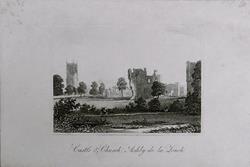 Leicestershire. Ashby de la Zouch. Castle & Church Anon. This engraving is apparently unknown to the internet. C19th. 1827 or later - 15.5 x 10 cm Original antique steel engraving. It is taken from a different angle to the known engravings. What is this wheeled vehicle? Larger image 1 : Larger Image 2 Ref 41195 : £10 Return to Antique Prints & Engravings Index |
> Section 1 > Section 2 > Section 3 > Section 4 > Section 5 > Section 6 > Section 7 | |||